Six Memos for the Artist-Philosopher
October 15, 2026
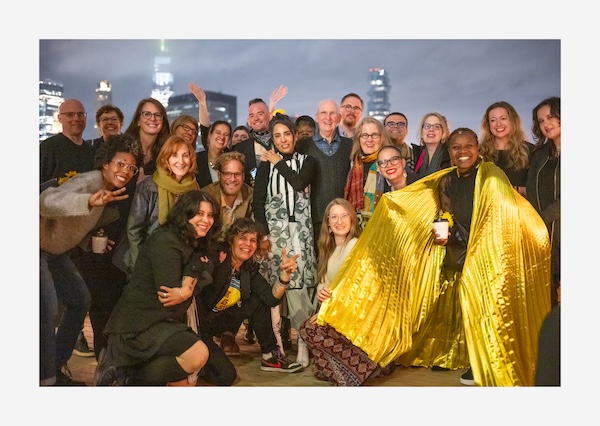
We recently returned to a toast offered by IDSVA President Simonetta Moro and IDSVA Professor Dejan Lukic at the 2024 gathering, The Ethos of Care, hosted by the IDSVA Alumni Association in New York City in 2024. The toast, "Six Memos for the Artist-Philosopher” pays homage to Italo Calvino's Six Memos for the Next Millennium: six virtues Calvino wished to carry into a new century of literature, reimagined here for a new century of art and philosophy.
______
We are now fully in the 21st century. Technology, new and old, is changing who we are. What forms will thinking, through art and philosophy, attain in the coming years? We cannot speculate too much about it. But we can offer some virtues, or characteristics, of a figure that will live through, and perhaps counter, these changes: the artist-philosopher. Reference to Italo Calvino’s Six Memos for the Next Millennium (written at the end of the 20th century) is of course intentional.
1. Emergence: "Philosophy is not a body of doctrine but an activity" (Wittgenstein). Art is a practice that generates thought. This generation constitutes an (ever-becoming) emergence. There is then no separation between life and art, making and thinking, art and philosophy.
2. Questioning: A question well posed is our ethical reward. Art and philosophy start with a question; where art is the manifestation of a question, philosophy is the articulation of it. Every answer is provisional. The hermeneutic circle has no end. The questioning brings beings to life.
3. Transhumance: Art and philosophy have no proper ground. Rather, they cross ground(s). The artist-philosopher is one with the rootless, with the migratory, with the foreign, and the stateless. Through "walking" they create thinking. Through thinking they create space. Always moving toward free space without knowing its location. Trusting the process means: trust where the path will lead you.
4. Multiplicity: Dispersion and polyphony is our answer to the One and to the Dual. Not one voice but many, not one narrative but many coexisting ones. Against Univocal Thought (Vattimo) a plural world drifts into multiple Oneness. And the further we move across the ground, as a movement of questioning, the closer we come to "embracing the entire universe" (Calvino).
5. Care: The artist-philosopher is the one who practices the ethos of care. Through meticulous forethought. Through attentiveness that provides vision. Almost prescience, a desire to recognize the world as poiesis. Artist-philosopher is the one that brings-forth.
6. Silence: The process of becoming leads to quietude. This process is embodied in a humble axiom: that which you practice you should not talk about. The act itself is the word. And silence is a shelter where bringing-forth, as a sense of care, becomes an act.
_________
These six memos are a living practice for the IDSVA artist-philosopher: Art worth making, questions worth chasing, ground worth crossing, care worth taking, and work eventually trusted to speak for itself.