
Spuren de l’Athar أثر Post-Reality of Montresso
February 19, 2026
by Justin Gallant, Cohort ‘24
The Reversible Jacket
You begin the day on the bus with Ya-Ya—an intertextual topology born from movement, chilled, splashed with UV rays, and placed in a directional metal tube. The morning is brisk; you opt for short sleeves to take in the cool air while the sun rises. The entrance invites you in with a series of sculptures, manicured trees and plants carrying olives, lemons, and oranges. At the Montresso Art Foundation*, you walk up to the younger lady guiding the group. Someone tells her the jacket is inside out. The jacket is easily reversible; only a small tag insists on which side is which.
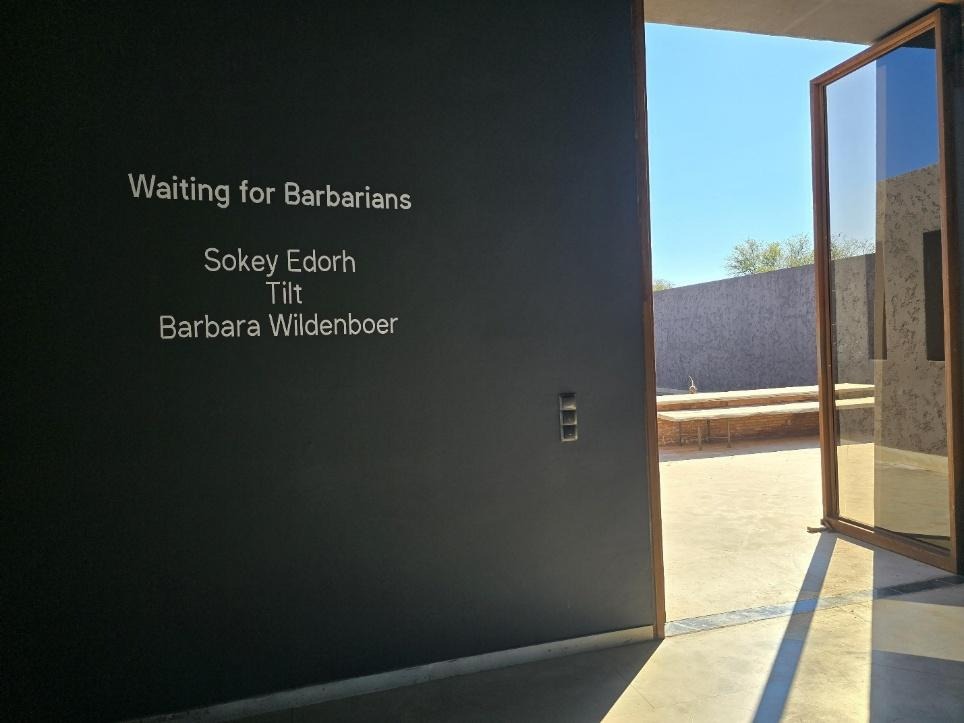
You tell her binaries are impractical anyway—when there is a 50/50 chance, it becomes impossible to tell them apart. Left or right, inside or outside, port or starboard. She says she was in the mood for this kind of conversation and agrees. You round up everyone and another lady introduces the art. The first part of the exhibition is anchored in the theme “Waiting for Barbarians.” Barbara Wildenboer uses strings to connect two sides: Art and Nature, Creator and Worker. The guide notes the artist is constantly representing “the two sides”—a common contemporary move to collapse the binary into a unification trick. You see an indistinct entanglement rendered by the actual string: a literalization that, in attempting to undo the binary, freezes it in place, and thus is only resolved by being made decorative.
The Bloch Node and Land Talk
You walk back to Silvia and hand her the Bloch bloc sticker you and Lucas made. She pauses, looks at the sticker—a reference to Ernst Bloch, whom she teaches—laughs and gets excited, saying she will message Lucas.
This behaves as a recursive “Trace” (Spuren)+—a callback to the game played the day before, where meaning only existed through repetition and misrecognition. The game was a literal mutation of the word: mishearing Toulouse, writing down To loose, which then continued into Too lose → Two Louis → Tool-oui-s. In handing over the sticker, you are handing over a remainder of that linguistic decay.
Halston points out the salt accumulations on the ground that were unintentional; an accidental blooming from the earth that she heard emerged shortly before the visit. Sokey Edorh’s work explains the “Barbar-Berber” node: the “other,” the voice rather than the savage. Functioning here as “land talk” having a voice—barbarism shedding its savagery and pointing instead toward its untranslatability. You walk to the last artist in this triad and see he is, fittingly, from Toulouse, a city in Southern France.
Speculative Domestication
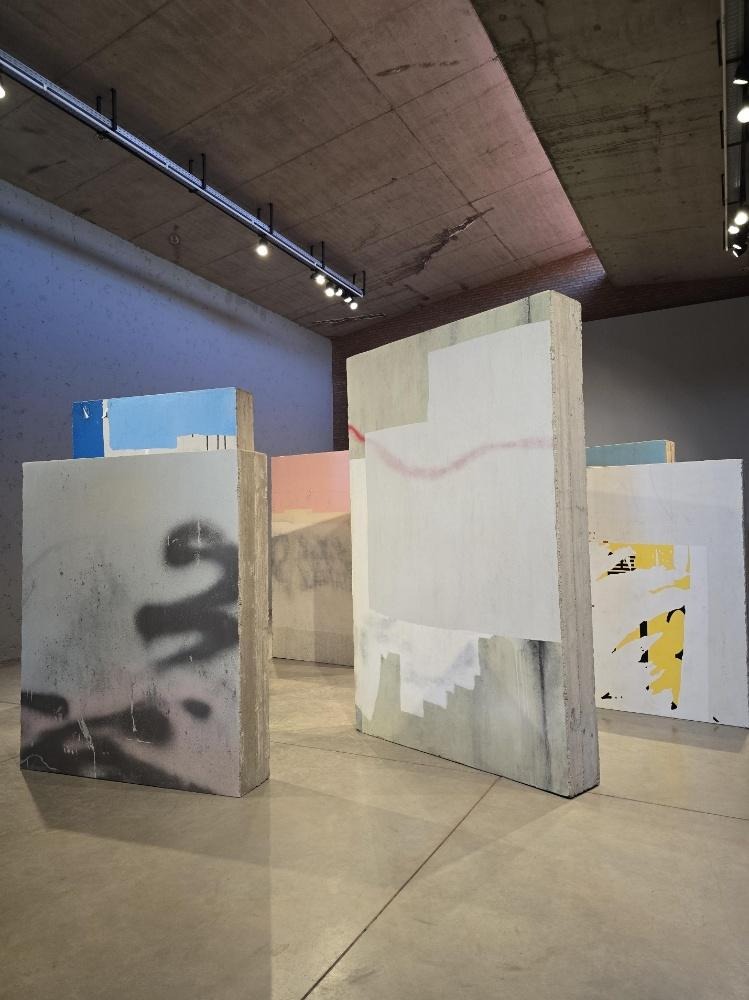
The artist, Tilt, works with fragments of immigrant identities and the “Barbarian act” of graffiti. He recreates pieces he has seen on concrete slabs—a simulated process you identify as Speculative Domestication. In the bookstore, there are prints of the walls; you can take home your own little concrete slab in a frame for $1320.
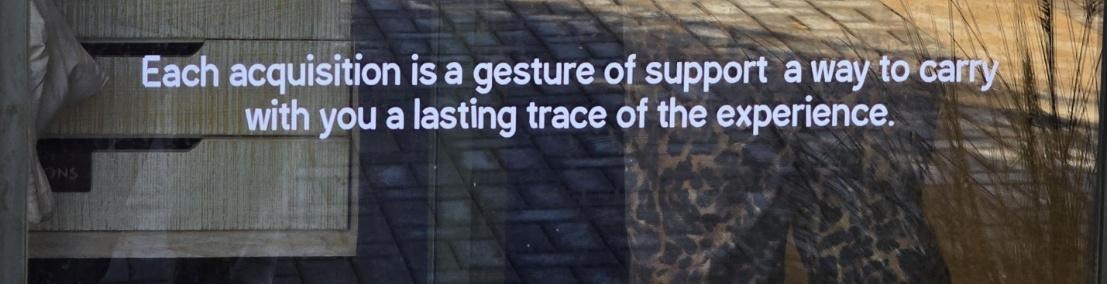
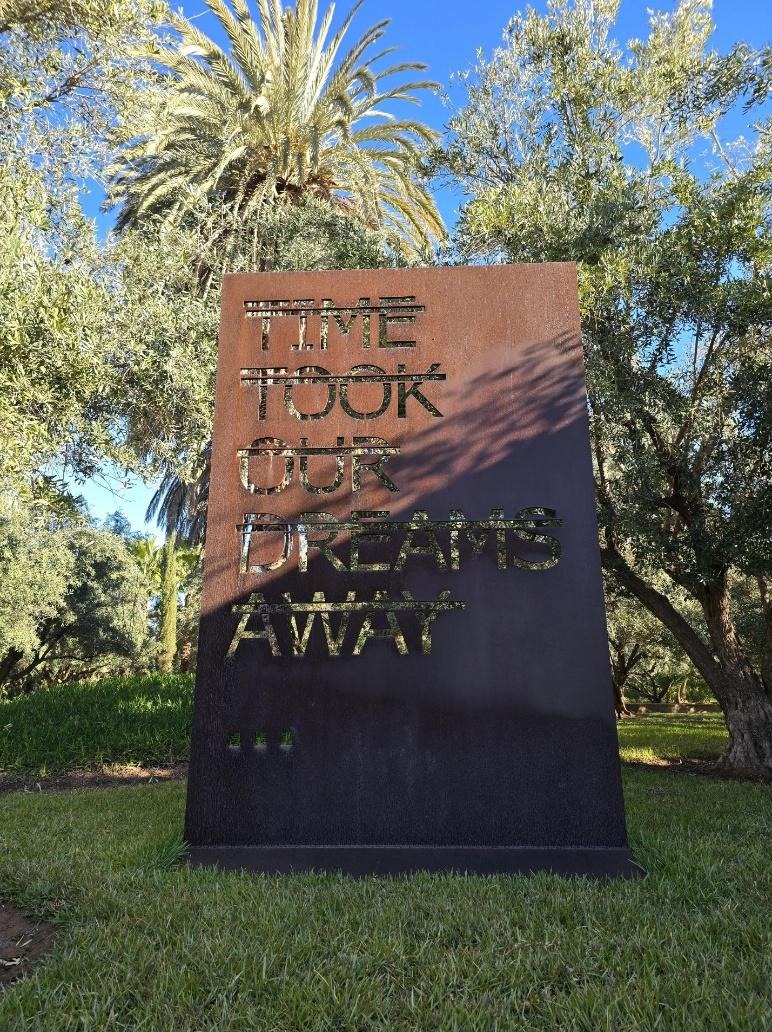
A sign next to the shop reads: Time took our dreams away. The store window reminds you that these are “traces of experience.”
Outside, however, the traces are less curated. You notice the way different countries negotiate their remainders—the presence or absence of trash cans as a cultural signature. Some cities make the bin a ubiquitous monument to order; others, like Marrakech, seem to hide them, forcing a different kind of “land talk” for the things we want to discard. An overripened olive falls to the ground, and a domestic tension plays out on the sidewalk: do we frame our waste, or do we let it become part of the salt of the earth? Silvia tells you that her new artist's name is “Toulouse-Le-Trash.”
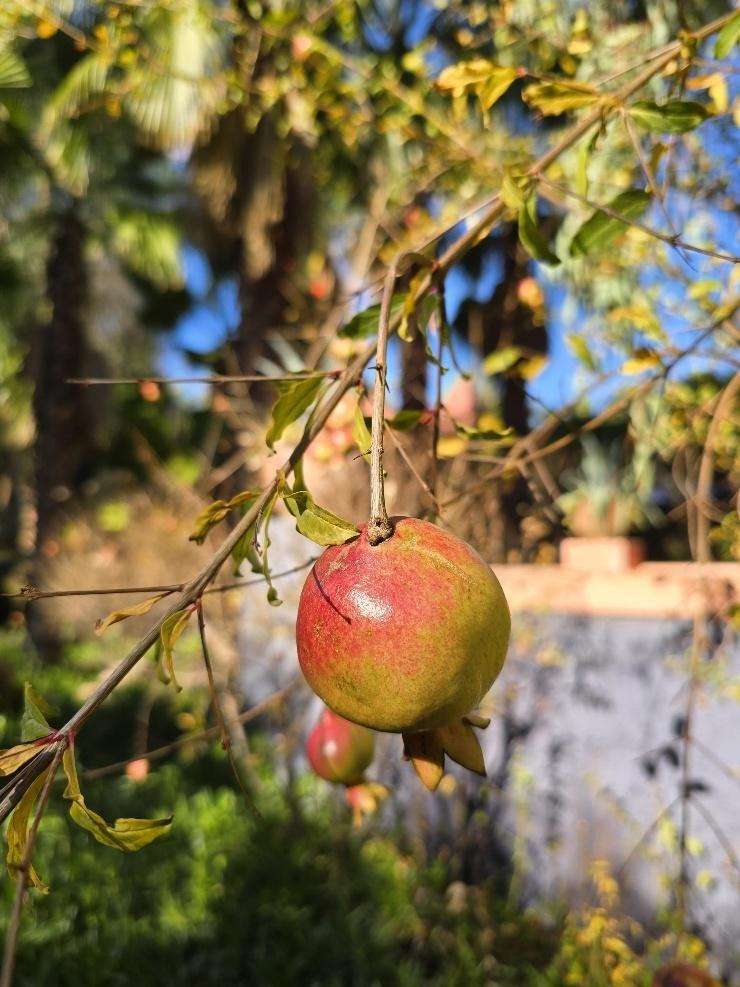
The recursion continues through a winding trail peppered with contemporary objects, artist spaces, maroon ripened olives and fully formed pomegranate trees concealing a rather amiable peacock. Inside one perch—Utopia 24 in a working studio. The artist, Roxanne Daumas, generates AI pictures of urban architectures from 1920–1990 to tell a narrative of how we live through hallucinated recreations. You see the speculative domestication even of the glitch artifact: she corrects the AI problems with Pierre Noir and UV light until the fiction is more realistic than the photo—a drawing correcting the “fragility of memory.”
A triangulation of pressures—French, Arabic, and the purely affective—struggles through the traversal into English, seeking a form that refuses to be flattened. Silvia points out the hegemonic problem. The language we use to describe art—the mayonnaise language—is a binder. Sometimes it’s a bland necessity that fills space but lacks the salt of actual distinction.
You are served Moroccan tea and the sugar is a material weight, a grounding sweetness amidst the heavy air of the gallery. At a fork on the path a sign on one side reads: Words escape and acts mark. On the other side, passing the institutional signage for the Espace d’Art Montresso, the linguistic decay of the tea-drunk mind takes over. The 's' in Espace slides; you read it instead as Escape d’Art.
The institution unintentionally names its own exit. If words escape, then the art space is merely the site of that fleeing. What remains is the act—the pour of the tea, the heat of the glass, the "land talk" that doesn't need the binder to be felt.
Coda: Oscillation vs. Traversal
You stand in the silence of the gallery for a moment, watching the way the UV light hits the corrected AI architectures. The air is still. It occurs to you then that the movement you are witnessing isn’t a movement at all.
You talk with Jesse about Lyotard and Metamodernism—the oscillation between modernism and postmodernism. But this oscillation is a symptom of an absence of sufficient explicit data. Oscillation is not movement; it is entropy. It creates a breakdown where boundaries either shrink into indistinction or expand into a featureless unification.
Movement requires a Third Node (at least three being the minimum for tensive-multiplicity) or agent to allow energy flow and geometric tensegrity. Binaries are not complemented by combining them; they require at least a third attractor to pass through phase changes and identity dissolution while maintaining a form. This attractor is born implicitly—and is therefore easily overlooked. Contemporary anti-binary bias participates in this as it oscillates toward entropy or expansion—both end in non-distinction. The problem presupposes binaries, mistaking oscillation itself for movement. Traversal requires tension without resolution, and rerouting that includes collapse.
Field Work: The Remainder
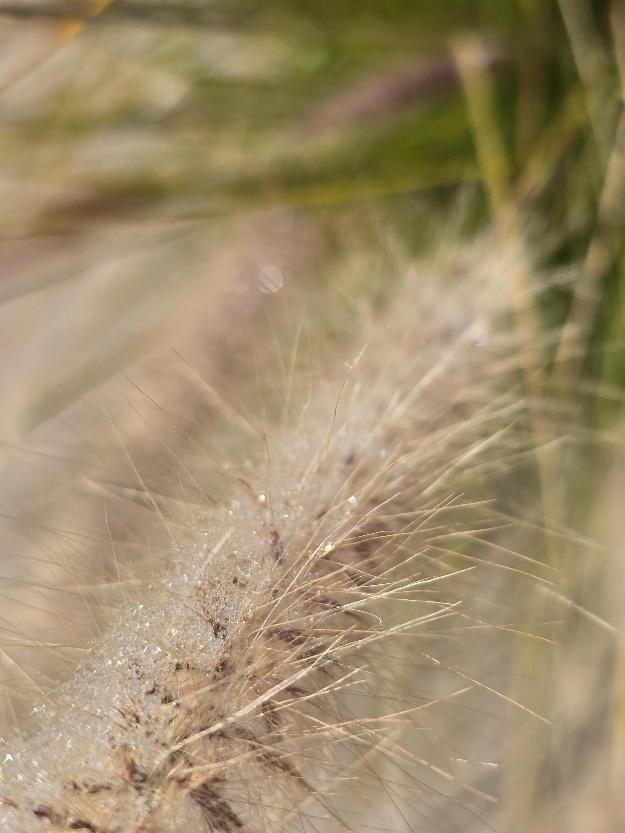
You notice dew drops on the cattails outside. The atmosphere is still brisk enough for them to maintain their form before evaporating, hydrating the plant, or simply dropping to the ground. You see JC at the water fountain.
“How are you doing?”
He pauses, watching the water condense as a flow and then break.
“Trying to be a fountain,” he says, and shrugs, as if unsure whether that counts as an answer.
You say that the tension of this place is productive—a co-pressure. You thank the younger guide. She moved here from Casablanca recently. Unlike Marrakech, she says, Casablanca conceals itself. Marrakech makes itself open to non-Moroccans. You discuss the pressure Silvia pointed out—the mayonnaise language; the bland binder used to fill the gaps between distinct pressures (one appropriate for specific, but not all meals). The guide admits she knows the technical concepts every artist uses. You tell her it’s funny how often artists obfuscate work with technical-sounding air that gives it theoretical weight. She says if they could explain it in precise language, they wouldn’t work in a plastic-visual medium and should instead be writers.
As the tour ends, Halston (who pointed out the salt accumulations) approaches and hands you a small mushroom she found on the damp earth near the olive trees. You hold it in your hands, an Athar أثر ^—the trace that is not a record in the mayonnaise sense, but an imprint on the recursive body—the third node acting as the salt.
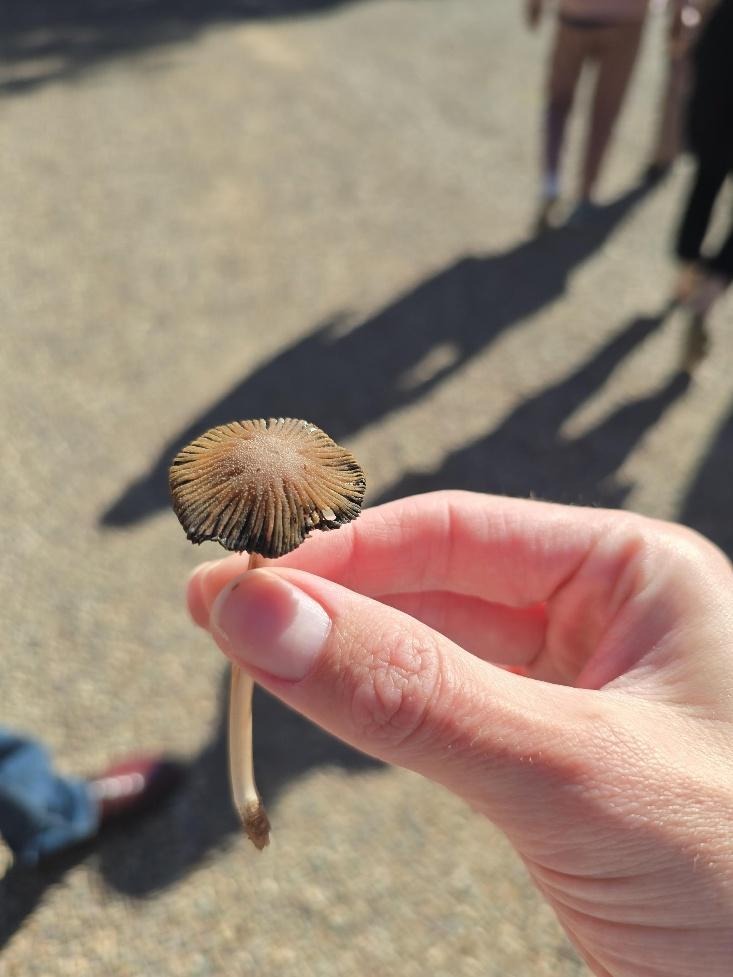
* Montresso Art Foundation, Marrakech.
+ “Spuren” (traces) is used here in the Blochian sense of remainder rather than origin.
^Athar (أثر) is frequently translated as “trace” or “ruin,” but in this context, it refers to the vestige of an impact. Unlike the Western “archive,” which seeks to preserve, Athar acknowledges the passing of time and the physical mark left by a body or a thought upon a landscape.
Note on the Visual Athar: All photographs are the author’s own, captured as immediate imprints of the traversal. Material remainders that resist the flattening of the binder language; material anchors in the triangulation of Air, Trace, and Salt.
- Figure 1: The Amiable Ripening. (The pomegranate as a tensive fruit, ready to break).
- Figure 2: The Threshold of Barbarians. (The door and light as the entrance into the theoretical binder).
- Figure 3: $1320 Domestications. (The concrete slabs as simulated and framed "Barbarian acts").
- Figure 4: Window / Residue. (The "traces of experience" message as a self-aware store window).
- Figure 5: Temporal Decay. (The "Time took our dreams away" sign as an accidental blooming).
- Figure 6: The Brisk Hydration. (The dew on the cattails as a form maintaining its tension before evaporation).
- Figure 7: The Final Node. (The mushroom: the actual imprint that survives the mayonnaise discourse).
Legend
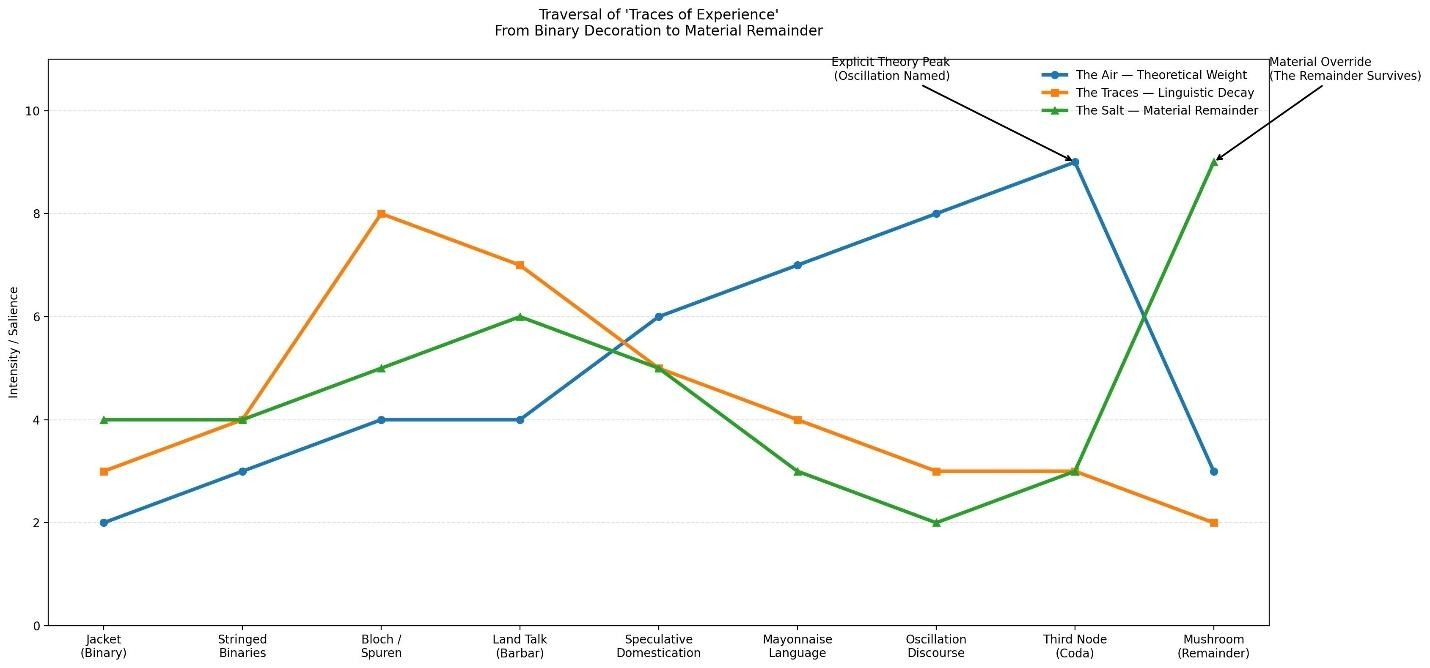
This chart tracks the traversal enacted in Traces of Experience across three interacting intensities.
The Air (Theoretical Weight) marks the accumulation of explicit conceptual language. It rises as explanation, framing, and binder discourse intensify, peaking at the Third Node (Coda) where oscillation and tensegrity are named directly, then collapses as theory exhausts its function.
The Traces (Linguistic Decay) follow misrecognition, mutation, and untranslatability (Spuren). They peak where meaning is generated through breakdown rather than clarity and diminish as framing suppresses linguistic drift.
The Salt (Material Remainder) tracks what resists capture: residue, waste, bodies, dew, and finally the mushroom. Repeatedly flattened by domestication and discourse, it returns at the end as a material override—the remainder that survives traversal.
Logic of the Spike: Movement occurs when theory and remainder converge to create tension without resolution. The final spike marks traversal, not synthesis.