
Searching for Hassan EI Glaoui's "Men on Ponies"
February 19, 2026
by Rebecca Monaghan, Cohort '23
A little history about our artist, from the family's profile:
Hassan El Glaoui was born in Marrakech, Morocco, in 1924 to Thami El Glaoui, the Pasha of Marrakech. The artist credited British Prime Minister Winston Churchill with persuading his powerful father to let him pursue painting as a career, particularly after a 1943 meeting in which the Pasha sought and received Churchill's opinion of his son's paintings. Hassan El Glaoui was a descendant of a 300-year-old Berber dynasty, but after his father's death, he was forced into exile. His family’s wealth was confiscated, and he was imprisoned. Upon his release, he relocated to a Paris suburb, where he lived with his French wife in a modest two-room apartment. Beginning in the early 1950s, El Glaoui studied at the École des Beaux-Arts in Paris under the tutelage of Jean Souverbie and Émilie Charmy. In 1965, he returned to Morocco, where he held his first exhibition under a tent (Glaoui, 2025).
Ah, Morocco—a land I will always cherish. In this essay, I recount my journey to find an artwork, an artist, and the enigma that began with the phrase "men on ponies." As the curator of the Everett Museum of History, I oversee a collection that has been part of our community for over 70 years. With more than 100,000 objects, the museum has weathered its share of challenges, including relocating items and rescuing them from fire and flood. The collection has been housed in various buildings before finally finding a permanent home in our under-construction location. During one of my collection recovery efforts, I discovered a piece labeled “Men on Ponies.” Although the artwork was well wrapped, I found no accession number or provenance. It was simply marked in large letters: “Men on Ponies.” You can imagine my intrigue when I stumbled upon it in a stack of objects. Upon opening the package, I exclaimed, "These are not ponies; they are Arabian horses, and this is an original!" Eureka! The questions flooded my mind: Where did this amazing artwork come from, and how did it end up at a small history museum in a historical mill town like Everett, WA?
My friend and I came across a small snippet from an old Everett Herald article, taped to the painting's cardboard backing. It stated that "Hassan El Glaoui, the artist, is the son of the former Pasha of Marrakech. At just 27 years old, he earned the distinguished title of 'Artist Laureate of Morocco.' In 1951, with the support of A. Conger Goodyear, one of the founders of the Museum of Modern Art, he held his first solo exhibition in both Paris and New York. Since then, his work has been showcased in Berlin, Hamburg, London, and at major Paris salons” (Herald.org). After a quick search on my phone, I found that Hassan is well known in Morocco for his paintings of horses and the traditional ceremonies of the Royal Guard. Much to my excitement, at that time, I was scheduled to travel to Morocco in a few months, which would provide the perfect opportunity to learn more about Hassan El Glaoui.
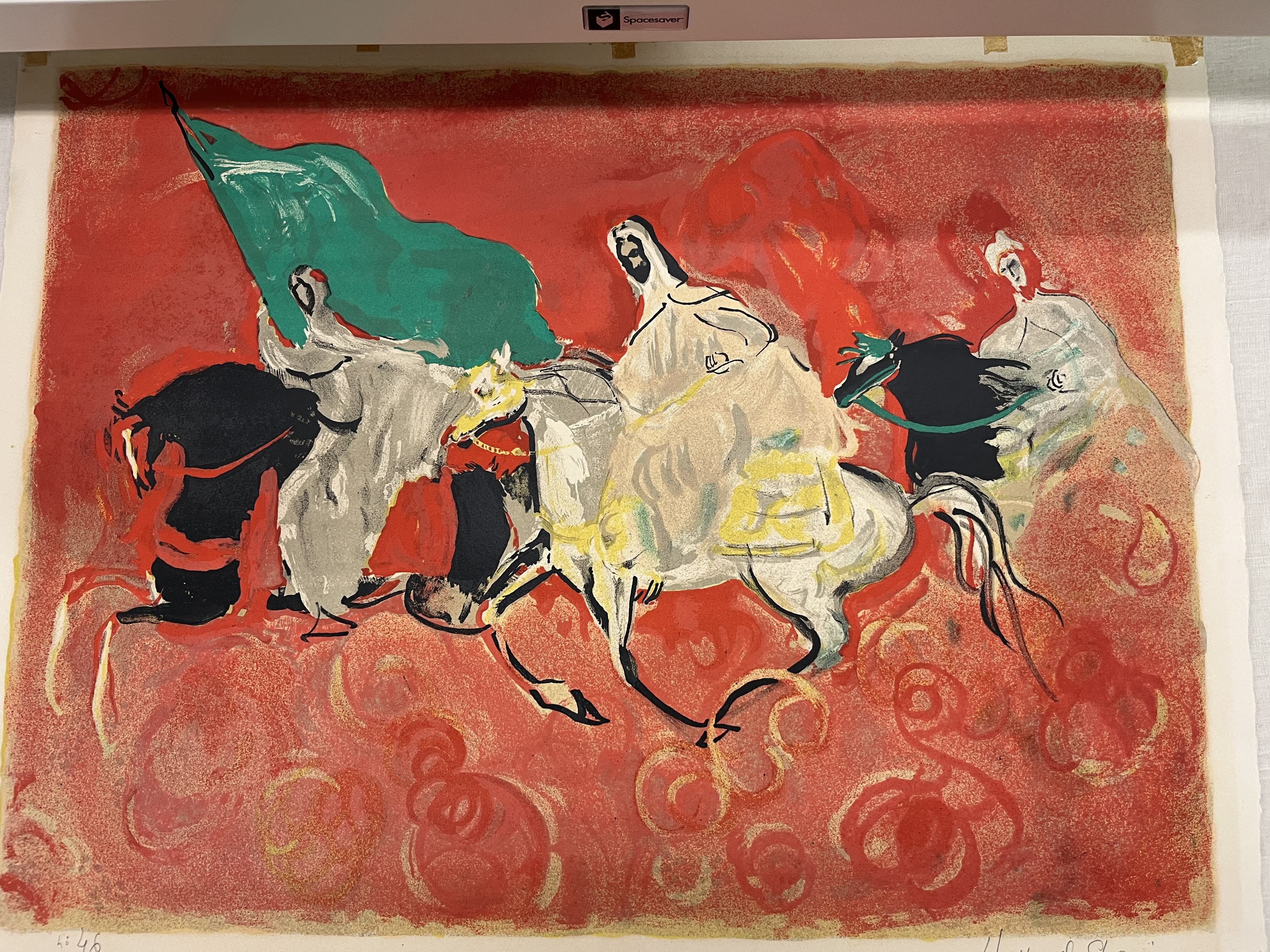
Flash forward to our first museum visit of the day during our residency in Marrakech, Morocco. We visited Es Saadi Palace to tour ‘From Morocco with Love’, an amazing exhibition spanning many levels of Moroccan art's history. To my serendipitous delight, around the first corner, one of Hassan’s works, ‘men on ponies’ (no photos allowed), took my breath away like a teenager at a rock concert. This large canvas was full of horses and men in regalia; a very large oil painting with legions of these horses and men, so many that it was dizzying to count. It was an oil painting in the same style as our painting, with a color palette of deep greens and blues. It was all starting to come together. I had a moment with the curator after our visit, and he looked at the photo on my phone and agreed that Hassan El Glaoui was “very famous.”
Later that afternoon, during my visit to the Museum of African Contemporary Art Al-Maaden (MACAAL), I had the pleasure of viewing another exceptional work by Hassan El Glaoui from their collection. In the photo below, you can see our wonderful educator, who guided me in discovering El Glaoui's works, including a striking self-portrait featured in the exhibition Le Sel De Ma Terre (Salt of the Earth), curated by his daughter, Touria.
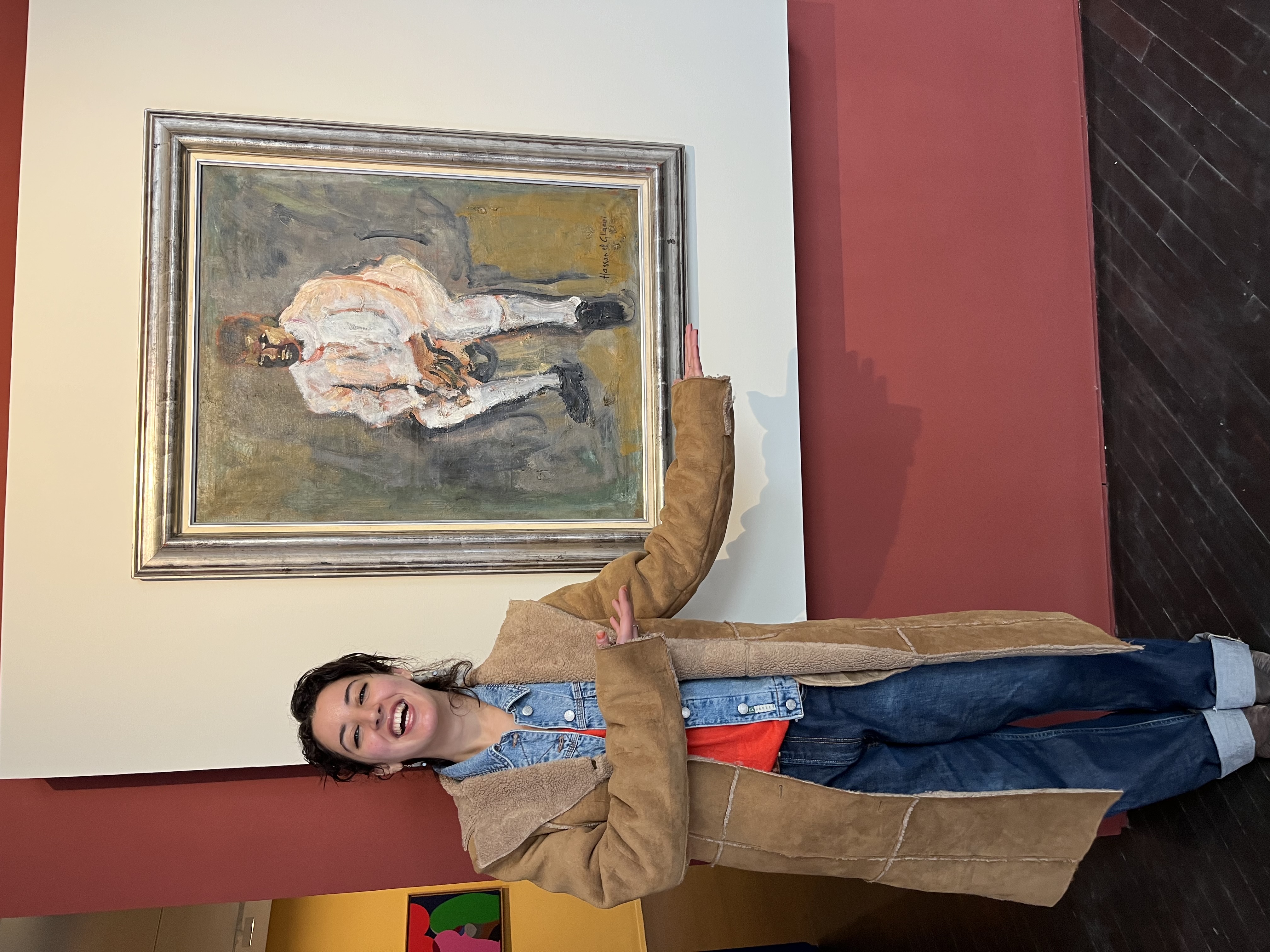
From ponies to the young son of a Pasha in Marrakech, my discovery of Hassan and his culture offers a unique lens for understanding his works. These works evolve from traditional painting, drawing on the history and sensibilities that have shaped them. In the Seven Contours One Collection, the chapter titled "Promise" features Hassan’s self-portrait, suggesting that this ambitious and culturally attuned artist continues to thrive as a beacon of promise, opening new avenues for others through the historical movements his art embodies. The magnificent Arabian horses and their riders have forged a path for perceiving African art as a “promise that evokes nostalgia while awakening the senses” (Montazami et al., p. 115), inviting us to engage with the unified phenomenon of the future. What the future holds is another visit to Morocco and further investigation of Hassan EI Glaoui and the influence his artwork has carried into a new generational movement. Many thanks to the curators and educators at the galleries and museums mentioned. I will see you again!
Works cited:
Hassan EI Glaoui.” Herald.org
Hassan El Glaoui, Instagram
Montazami, Morad, and Madeleine De Colnet. Seven Contours One Collection: Exposition Permante MACAAL, 2025. Musée d’art contemporain africain Al-Maaden, 2025.