
Santiago Zabala’s Book Launch: Signs from the Future: A Philosophy of Warnings
February 19, 2026
by Rummy Gill, Cohort ‘20
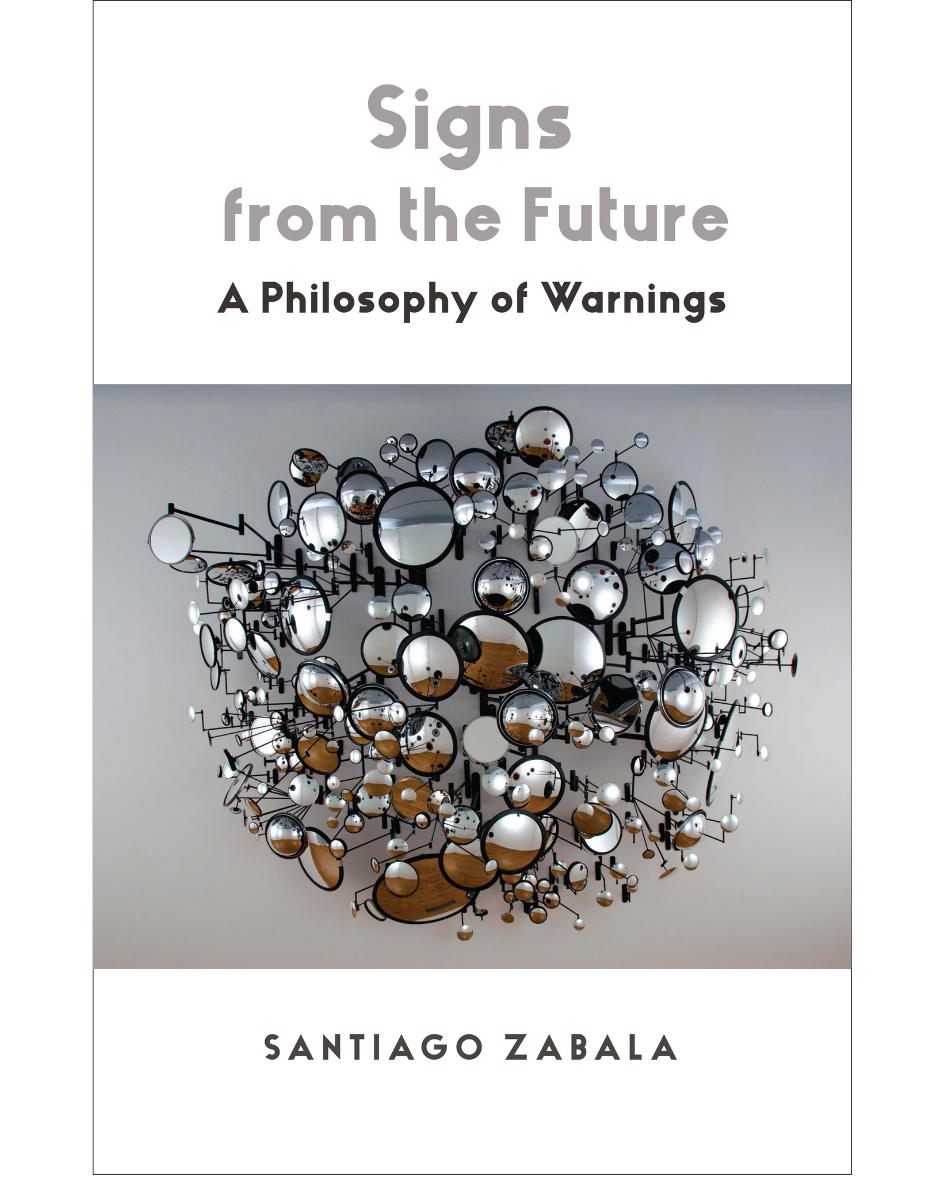
This online session marked the launch of Dr. Santiago Zabala’s new book, Signs from the Future: A Philosophy of Warnings, published by Columbia University Press (Fig.1). Hosted by the Institute for Doctoral Studies in Visual Arts (IDSVA) and moderated by Dr. Silvia Mazzini, Director of IDSVA, the session brought together Zabala with two panelists, Dr. Simonetta Moro, President of IDSVA and Dr. Martin Woessner, Professor of History and Society at the City College of New York’s Center (CCNY) for Worker Education (CWE). The session centred around a conversation on philosophy as a warning and on the idea of the artist-philosopher, with questions posed by Woessner, Moro, and Zabala supplying responses.
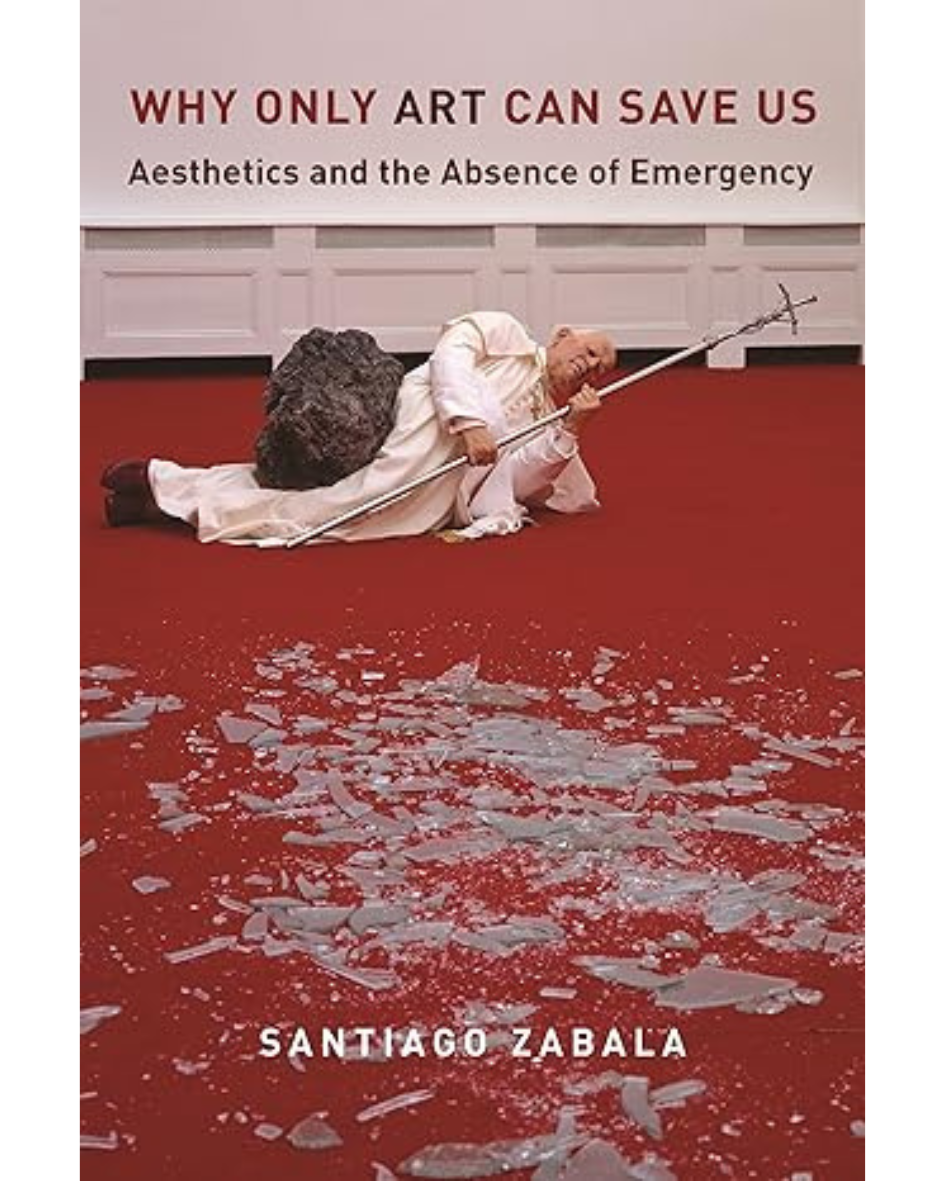
Mazzini opened by establishing Zabala as a long-standing collaborator and “friend of the community,” serving as one of IDSVA’s Dissertation Directors and as an Independent Study Director. Currently, Zabala is a Research Professor of Philosophy at Pompeu Fabra University in Barcelona, and Mazzini describes his new book as “a much-needed inspiration” that invites reflection on responsibility, “engagement and a possible task” that we might want to embrace. Like Zabala’s earlier work, especially Why Only Art Can Save Us: Aesthetics and the Absence of Emergency, Mazzini suggests that this book quite strongly continues “a dialogue between the arts, artists and philosophers” (1.13-2.04; Fig. 2).
Zabala began by explaining that Signs from the Future is not a “new philosophy” in the sense of invention, but rather “a new reformulation” of a neglected question: why we fail to “listen to warnings.” Zabala argues that philosophy, through its history, has functioned as a form of warning. So, firstly, Zabala indicates that his book is “a justification that philosophy is a warning” rather than simply “a method.” And secondly, the book is about “how we have not listened to any of these warnings.” He states that philosophers have repeatedly tried “to warn us about many different things,” whether they be ethical, political, or existential; yet their warnings have been ignored.
The book unfolds in three parts, “philosophical warnings,” “ignoring warnings,” and “being warned,” and suggests that philosophy is not simply about producing knowledge but rather about engaging the world. First, it shows how philosophy itself is fundamentally a practice of warning. Second, it demonstrates how we have failed to listen, not only to philosophers, but also to scientists. Zabala stresses that the problem is not whether we choose between philosophy and science, because we have failed to listen to both. This failure becomes, for Zabala, an “existential problem," and he feels that “it is not something that social scientists will be working on, but rather it is something that philosophers will actually begin working on.” He points to “COVID-19” as a clear example: many warnings existed long before the crisis, yet they were largely ignored. In the third part of the book, Zabala turns to the arts and the humanities as spaces where warnings might again become audible. He insists that we are now in a condition where we can barely translate “the actual word warnings.” For Zabala, environmental philosophy, plant philosophy, and similar fields are already forms of warning, even if they are not always recognized as such (6.01-8.40). Zabala read two passages from the book. The first, drawn from chapter two around his discussion of “Heidegger’s most renowned affirmations, which has been deeply misunderstood” that “science does not think,” clarifies that Heidegger was not anti-science, but rather critical of a technological way of thinking that reduces the world to what can be calculated and controlled, producing alienation, creating “an Unheimlichkeit condition", one of “uncanniness” or “homelessness,” and also increases Angst, as we are only left with “purely technological relationships” (Zabala, Signs 34 -35). The second passage, from chapter six, that engages with the Netflix series Black Mirror (Fig. 3), illustrates how popular culture can function as a warning about the direction in which technological society may be heading. Zabala emphasizes that together these were “a good illustration of a warning itself, or at least we can interpret it that way.”

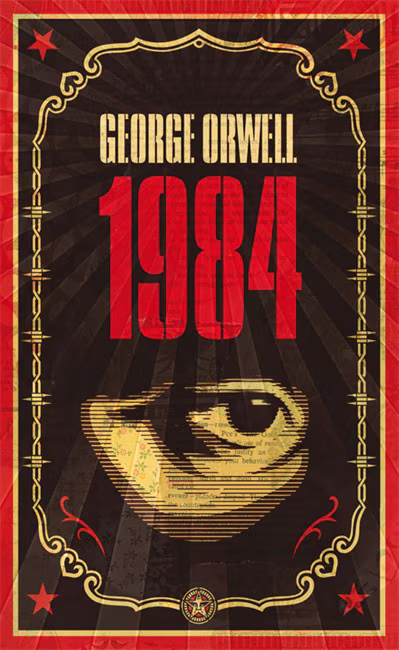
The first panelist, Woessner, framed his questions around three interconnected themes: “the role of the philosopher, the role of narrative in the arts and in philosophy, and the question of existential action” (22.30-22.34). He praised Zabala’s book for combining philosophy with contemporary debates about pressing crises we are facing today, including “climate change,” “authoritarianism”, gender backlash, and “artificial intelligence.” What interested him the most was the structure of the book, which read as an argument about what philosophers should do today. Woessner addressed Nietzsche, Simone de Beauvoir, and Hannah Arendt, philosophical thinkers who engaged in “cultural practice” and “cultural politics,” whereas Heidegger remained largely “an academic philosopher.” He asked what a “warning philosopher” should look like today, and whether figures like Greta Thunberg should be considered philosophers, or should philosophy and activism remain distinct? Given Zabala’s long-lasting interest in art, Woessner asked how narrative in literature can function as a form of warning, especially like Orwell’s 1984 as an example of narrative warnings (Fig. 4). As literature was an important site for both Richard Rorty and Gianni Vattimo, he asked about the difference between predications and warnings. Finally, he raised the “question of ‘will,” suggesting that what really matters is whether warnings can transform how people live and act in the world, and felt that “hermeneutics in this reading is about existential self and transformation,” in which case, we need a philosophy that changes us.”
Zabala answered Woessner’s questions as a collective. He argued that the role of the philosopher is to create “disturbance,” and a warning is meant to produce change now, not in the future. This is why the book places equal emphasis on listening and speaking: philosophy must not only issue warnings, but also to cultivate the capacity to hear them. For Zabala, predictions simply describe what will happen; warnings aim to change what will happen by altering how we act now. Warnings are always weak and incomplete as they point to something that is not yet fully present – an absence rather than a visible emergency. Drawing on Arendt, Zabala suggested philosophers must learn “to think about the invisible.” On Greta Thunberg, Zabala states that she is not a philosopher, nor does she need to be. What really matters is that philosophers can learn from the way her actions generated pressure and involvement at an existential level, something science alone often cannot do. Zabala also acknowledged the influence of Richard Rorty and Gianni Vattimo, especially Rorty’s call to move away from philosophy to get closer to literature and art. Zabala concluded by describing the present as “a horizonless society,” in which humanity increasingly struggles to imagine the future. Therefore, the inability to listen to warnings is directly tied to this loss of “horizon” (33.28-39.29).
The second panelist, Moro, focused on the relationship between art and philosophy, a central concept at IDSVA developed by its founder, George Smith: the artist-philosopher. Moro noted that Zabala begins each chapter of his book with a film and places an artwork on the book’s cover, giving artists a “special” role. Moro asked how art can function as a warning, rather than merely as a political critique or commentary on the present. Moro suggests that artists have often been attuned to what is “not yet seen” in society and asks whether warning art might be understood, in Nietzschean terms, as “untimely,” addressing a future rather than simply reflecting the present (40.58-43.23).
Zabala responded that not all art is a warning, just as not all philosophy is. For Zabala, some works merely describe the “status quo”, but artworks can become warnings regardless of what their creators intended. He points out the artwork on his book’s cover, even though the artists did not intend it that way, his art functions as a warning philosophically. Importantly, for Zabala, art creates events that allow us “to think differently about reality or the future.”Therefore, philosophers need art not to make better arguments but to make different ones – ones that cannot be produced by philosophical tools alone. He stressed that this is not about giving art absolute priority but rather recognizing how limited philosophy becomes when it refuses to learn from other forms of thinking (44.48-49.48).
In closing, Zabala’s book launch highlighted “A philosophy of warnings” and the concept of the artist-philosopher. Through the questions and insights of Mazzini, Woessner, Moro, and Zabala’s response, the session presented philosophy not as an isolated concept but rather as an urgent practice that aims to disturb, involve, and transform how we live in the world. Warnings, for Zabala, are easily ignored, but precisely for that reason, they should position us all to actively listen, think, and imagine a future that still might be changed.
Works Cited
Santiago Zabala Book Launch, 15th November 2025: https://drive.google.com/file/d/1Ey5h3EpdmfHOrE_D8-g55vmEiFY_zcjx/viewZabala, Santiago.
Signs from the Future: A Philosophy of Warnings. Columbia University Press: New York, 2025.