
Reimagining Space and Subjectivity: A Polyphony of Two IDSVA Authors
May 18, 2026
By Ariel Miles, Cohort '23
How can people begin to imagine life outside of the systems and concepts they are made to feel determined by? In what ways can people affirm, and feel affirmed in, experiences that do not align with those concepts? Before these questions can be meaningfully addressed, it is necessary to understand how social concepts are imposed and reinforced. Jacques Derrida reminds us that deconstruction is not destruction, but rather a genealogical investigation into how concepts are formed, stabilized, and maintained (Derrida 2).
In this spirit, IDSVA graduates Dr. Katherine Farrington and Dr. Jessica M. Rodríguez Colón introduced an engaged audience at Gallery MC in New York City to their respective explorations of Derrida’s concepts regarding physical space and (m)otherhood. I had the opportunity to listen alongside my five-year-old to the authors’ presentations, a mediated discussion, and a Q&A facilitated by Dr. Keren Moscovitch. Though their books differ significantly in subject and method, both address dominant social constructs and propose routes for reimagining them.
The evening opened with welcoming remarks from IDSVA President Prof. Simonetta Moro and Board Member and Chair, Prof. Paul Armstrong, followed by the authors’ presentations.

Dr. Kate Farrington began by sharing her book, Place-As-Medium and New Grounds for Thinking in Contemporary Art, expanded from her doctoral dissertation. The work introduces a mode of art practice in which artworks actively promote community and transform how people belong to places. Drawing on thinkers such as Jacques Rancière, Gianni Vattimo, and Martin Heidegger, Farrington examines artworks that operate not as representations of space, but as activations of it. She devotes particular attention to the work of Chilean artist and architect Alfredo Jaar, whose projects appear in multiple chapters of her book. Jaar’s Lights in the City, transformed the cupola of Montreal’s Marché Bonsecours into a site of ethical alert. At the push of a button, a person in a nearby shelter could send a distress signal that triggered a hundred-thousand-watt red light to flood the building, a type of light typically associated with fire emergencies. The installation reimagined a landmark monument as a collective signal, reminding a wealthy city of the unacceptable conditions endured by displaced people and reframing displacement itself as an emergency demanding response.


Through this and other examples, Farrington explores how the “gaze” can “shut down” space, limiting what a space is permitted to become. She argues that the gaze plays a critical role in determining whether a space remains static or becomes relational and generative. Her work asks what it might mean to conceive of space as non-representational: a site for gathering rather than viewing, for participation rather than consumption.
Dr. Jessica M. Rodríguez Colón continued the evening through an exploration of her text, Displacement of (M)others in Twenty-First-Century US Films: Impact on Maternal Identities of “Other” Subjectivities. Guiding the audience through media-affirmed narratives of motherhood, she argues that these narratives force mothers into reductive binaries of “good” and “bad,” displacing mothers from the complexity of their lived experiences and obscuring the more rhizomatic nature of maternal subjectivity.
Using the concept of “The Gaze Economy,” Rodriguez Colon examines how mothers are made to perform and how they are aesthetically represented, particularly in modern film. Drawing on Jacques Lacan’s understanding of the gaze as something lost to the eye, something that distorts objects through the subject’s phenomenal experience, she emphasizes the importance of reclaiming subjective narrative, especially in relation to motherhood. Her research involved repeatedly viewing 500 of the top-grossing films released between the years 2000 and 2019 to assess how mothers are portrayed in both leading and supporting roles. What she discovered, through both research and lived experience, is that maternal identity is far less fixed than popular media suggests. Rather, it is in constant transmutation. New narratives that reflect this fluidity require space to exist. With this in mind, Rodríguez Colón introduced her conception of the (M)other and discussed her interest in the visual decolonization of maternal roles, challenging reductionist frameworks that limit how mothers are seen and how they see themselves.
While Farrington and Rodríguez Colón approach different subjects, both articulate the gaze as part of a broader system that distorts, limits, and constrains potential. For Farrington, this manifests in how spaces are framed and who is permitted to meaningfully inhabit them. For Rodríguez Colón, it appears in how maternal figures are reduced and disciplined through visual culture. In both cases, deconstruction becomes a method for deviating from these systems and making room for alternative ways of being.
Farrington’s writing further develops these ideas through discussions of “time and space play”, as well as through works such as John Preus’s installation The Beast, which she described as personally activating. Similarly, Jaar’s Music, Everything I Know I Learned the Day My Son Was Born and The Skogall Konsthall honor and include the voices of residents within their communities, affirming collective experience and shared authorship. These projects do not merely represent communities and their spaces; they engage them, creating conditions for participation and belonging.
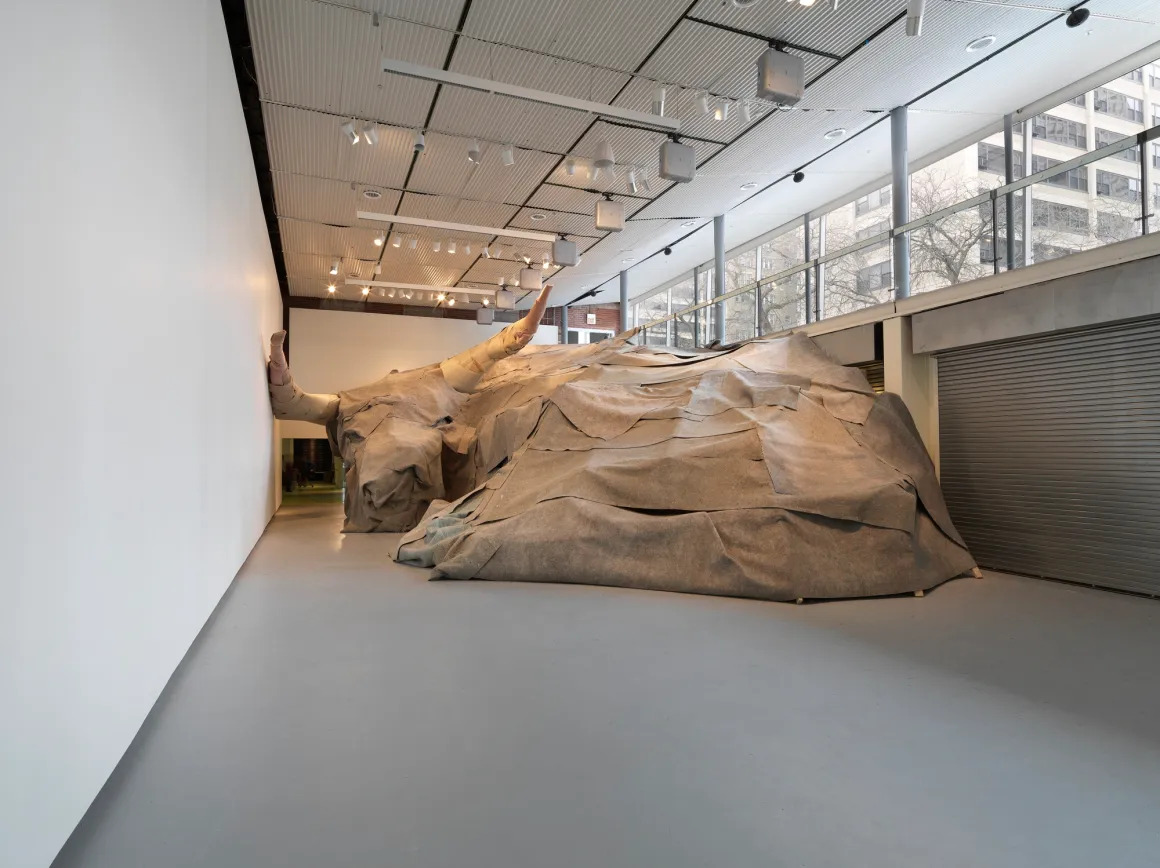
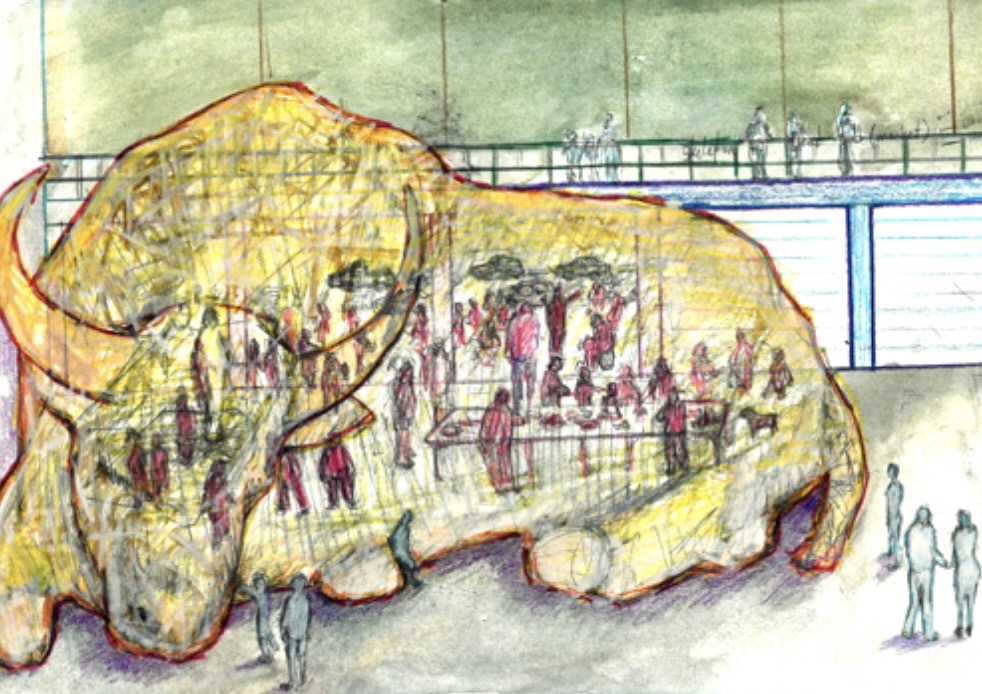
During the discussion and Q&A, both authors spoke candidly about their relationship to their work. Farrington shared that she has “lived place as medium,” while Rodríguez Colón noted that there is no deviation from her practice; it goes “wherever the practice wants to go.” Their responses underscored the ethical stakes of their research and their attentiveness to how their work operates in the world.
As the event ended, conversation and reflection filled the space. Introductions were exchanged among faculty, alumni, community members, and the authors, including with me and my five-year-old. In the closing moments of Farrington’s presentation, readers were left to consider what it means to share authorship of space and to dismantle narratives around who or what is permitted access. In those moments of meeting and greeting, the practices rigorously examined by the authors were made visible in real time. After two hours of sitting as quietly as possible while focusing on his game of Roblox, my son shook hands, danced with encouragement from others, initiated conversations, and exchanged ideas. Neither the space, nor motherhood, nor childhood, nor institutional roles were burdened by the gaze that the authors had so carefully deconstructed. New narratives, for space and for the (M)other, were not only discussed but enacted.
Works Cited
Derrida, Jacques. "Letter to a Japanese Friend." Derrida and Differance, edited by David Wood and Robert Bernasconi, Parousia Press, 1985, pp. 1-5.
Farrington, Katherine. Place-As-Medium and New Grounds for Thinking in Contemporary Art., Routledge, 2025.
Farrington, Katherine, and Jessica M. Rodríguez Colón. Lecture on Visual Arts: Philosophy, Aesthetics, and Art Theory, 31 March 2026, Institute for Doctoral Studies in the Visual Arts, New York. Lecture.
Jaar, Alfredo. "Lights in the City." 1999, https://alfredojaar.net/projects/1999/lights-in-the-city/
Preus, John. “The Beast”. The Beast - Solo Exhibition At The Hyde Park Art Center, 2014, https://johnpreus.com/selected-projects/sacrificial-beast-project/
Rodríguez Colón, Jessica M. Displacement of (M)others in Twenty-First-Century US Films: Impact on Maternal Identities of “Other” Subjectivities. Bloomsbury Academic, 2026.