
George Smith on The Artist-Philosopher in the Age of Addiction: Heidegger’s Climatology Reflections for the IDSVA Community
May 18, 2026
By Stephanie Inabinett, Cohort ‘23
.png)
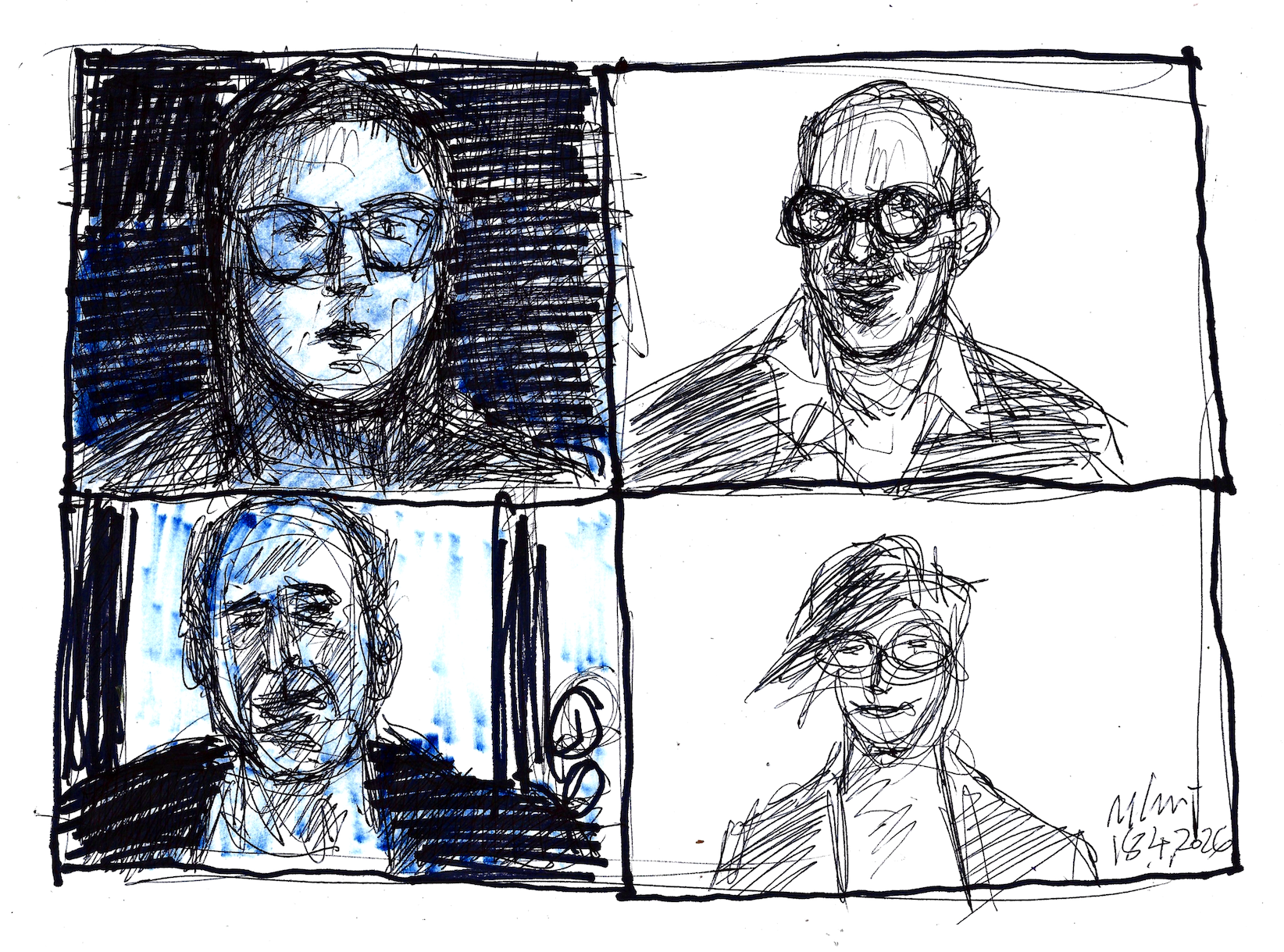
Conversations within the IDSVA community often move beyond their original subject. A discussion about a new book can quickly become a discussion about education, ethics, artistic practice, memory, or the challenge of learning how to think clearly in the present moment. That was certainly the case in a recent exchange with George Smith about his book, The Artist-Philosopher in the Age of Addiction: Heidegger’s Climatology. The interview focused on the book itself – its structure, aims, and broader philosophical questions, while also revisiting themes familiar to many IDSVA students and alumni: the distinction between information and knowledge, the role of uncertainty in rigorous inquiry, the relationship between art and philosophy, and the understanding of intellectual growth as an ongoing process – never fully complete. Smith spoke in a style that many who have studied at IDSVA will recognize. Rather than offering fixed conclusions, he developed ideas by revisiting them from different angles. One theme remained constant throughout the conversations: thought is never finished, and neither is the person engaged in it.
Every Chapter is the Most Difficult
When asked which chapter of The Artist-Philosopher in the Age of Addiction was the most difficult to write, Smith gave an answer that will sound familiar to anyone who has worked on a dissertation or long-term research project. “Every chapter is the most difficult chapter. The one that you’re in is the hardest one to work out.” His answer reframed writing not as the orderly transfer of completed ideas, but as a process of discovery. Each chapter becomes its own threshold, requiring the writer to move forward without certainty, often unsure where the work will lead. One section resolves only by opening onto another. For IDSVA students and alumni, this may sound less like metaphor and more like memory. Many know the long arc of proposal drafts, oral examinations, revisions, and the peculiar mix of frustration and exhilaration that accompanies serious intellectual work. Smith’s point is subtle but important: writing is not merely how we report what we know. It is one of the ways we come to know.
Beyond the Conventional Philosophy Book
Smith also emphasized that The Artist-Philosopher in the Age of Addiction was not intended to function as a standard academic monograph. He described the text as “really a storybook,” one that carries philosophical questions through narrative and poetic form. Where conventional philosophical writing often privileges structure, argument, and conclusion, Smith is interested in another mode of thought – one that moves through image, cadence, unfolding tensions, and narrative progression. He noted that the chapters are arranged with “a beginning, a middle, a climax, and end,” more akin to a novel or poem than a textbook. His aim, he said, was “to really poeticize philosophical prose.” This does not mean abandoning rigor. It means recognizing that form matters. Language can think through metaphor, rhythm, image, and narrative just as powerfully as through formal argument. Readers shaped by IDSVA’s interdisciplinary culture will likely recognize this approach. The institution has long attracted people who do not separate making from thinking, or art from philosophy.
The Artist-Philosopher Today
When asked what responsibilities belong to the artist-philosopher in the present moment, Smith drew a contrast between roles governed by fixed procedures and the more open demands placed on the artist-philosopher. “Generally speaking, the scientist has responsibilities that are predetermined,” he said. “They’re in the handbook.” Then he offered a different model: “The responsibility of the artist-philosopher,” he continued, “is the ability to respond to a given historical situation.” This is an important distinction. Responsibility here is not defined as following rules already written elsewhere. It is defined as responsiveness – the capacity to grasp a historical moment. This distinction feels especially relevant now. Many current challenges – political division, ecological instability, rapid technological change, and institutional distrust – cannot be solved by procedure alone. Technical knowledge remains necessary, but it is not enough. What’s in question requires discernment, judgement, patience, poetic imagination, the capacity to listen attentively – and poetically.
What Does George Smith Hope the Book Will Do?
Perhaps the most revealing question concerned what Smith hopes readers will do differently after reading the book. His answer did not focus on persuasion, agreement, or admiration. Instead, he acknowledged that the text is demanding and even suggested that it may not be “meant to be read” in the ordinary sense, but rather to endure as a document that could become meaningful under changed historical conditions. More immediately, however, he expressed a hope especially relevant to students and scholars: that readers might find the book incomplete, identify its limitations, and produce stronger work in response. He imagined readers saying that it is “a good start,” but inadequate in important ways – and then writing something that addresses what the book failed to do. Here we are given what seems a generous if demanding vision of authorship: the highest aim of a philosophical text is not passive admiration, but active continuation.
Continuing the Conversation
Together, Smith’s responses present The Artist-Philosopher in the Age of Addiction not as a closed system, but as an invitation. It is a book shaped by difficulty, written against narrow academic conventions, conscious of its own limits, and oriented toward future readers who may carry the conversation further. That stance may be the most significant lesson of the interview. Important books do not end discussion. They deepen it. In that sense, Smith’s most recent work asks not simply to be read, but to be answered.
To obtain a copy of The Artist-Philosopher in the Age of Addiction follow this link: https://www.routledge.com/The-Artist-Philosopher-in-the-Age-of-Addiction-Heideggers-Climatology/Smith/p/book/9781032564128. To listen to the full webinar go to: The Artist-Philosopher in the Age of Addiction: Heidegger’s Climatology.
Works Cited
Smith, George. The Artist-Philosopher in the Age of Addiction: Heidegger's Climatology. Routledge, 2025.